The honest limits of verbatim detection
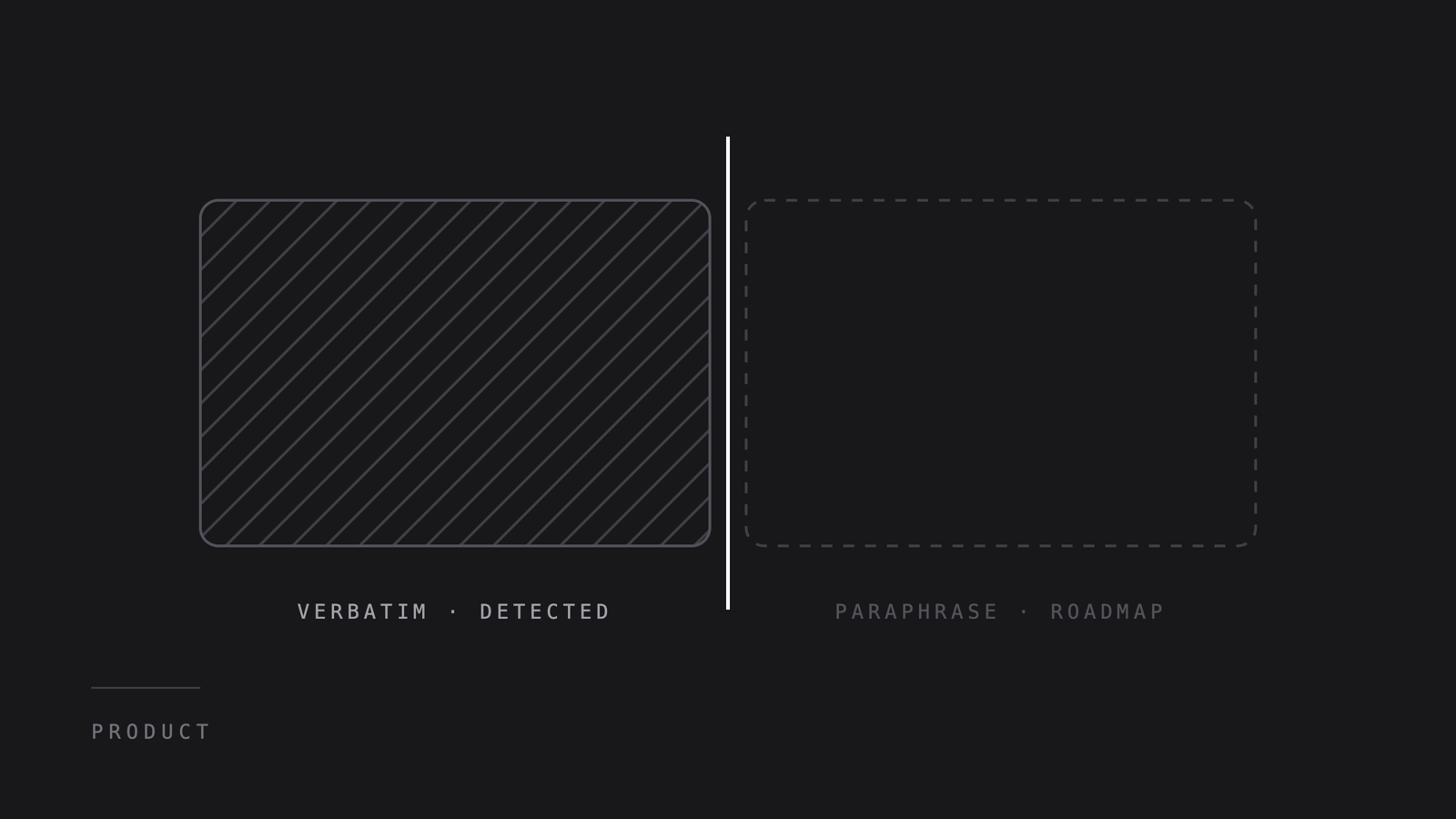
Our engine detects verbatim and near-verbatim copying. It does not detect paraphrase. Every plagiarism checker has this boundary — we're just the ones who put it in writing.
By Aleks Bochkov
Here is a sentence you will not find on most plagiarism-checker websites: there are kinds of copying this tool will not catch.
Every detection engine has that boundary. The difference between vendors is whether they tell you where it is. We think hiding it is worse than useless — a user who believes a tool catches everything will read "0%" as proof of originality, which is exactly the mistake that gets people hurt. So this post draws our boundary in public.
What verbatim detection catches
The Noplag engine detects verbatim and near-verbatim overlap: passages copied outright, or copied with light edits — changed punctuation, shuffled whitespace, a swapped word here and there. Matching is fingerprint-based, so it's robust to formatting tricks, and the final alignment stage recovers exact character positions, so every match in a report points at real, inspectable text.
This covers more real-world cases than it might sound like. Copy-paste is still how most actual plagiarism happens — students under deadline, content farms scraping articles, boilerplate recycled without attribution. Careful sentence-by-sentence rewriting is expensive; most people who'd do that work would rather just write the thing.
What it misses, specifically
- Paraphrase. Rewrite a passage in your own words and the five-word sequences the engine fingerprints no longer exist. A thorough paraphrase of someone else's argument scores 0%.
- Translation. Text copied from another language and translated is new text as far as fingerprints are concerned.
- Ideas. No tool detects stolen ideas expressed in original prose. Any tool claiming to is selling something.
- AI-generated text. Detecting whether a machine wrote something is a different problem from detecting copying, and we don't ship an AI detector until it passes our evaluation gate. Vendors that bolted one on in a weekend have published false-positive rates that accuse honest writers — we won't do that.
If a vendor's marketing implies their checker reliably catches paraphrase, ask them for the evaluation. Published, reproducible numbers — not a percentage in a testimonial. We publish ours, and the harness that produces them is in the open-source engine.
Honesty as product design
Knowing the boundary changes how the product should behave. Three examples from the report you'd only build if you took the limits seriously:
- A score is a pointer, not a verdict. Reports say what the percentage measures — textual overlap, in which quotes and citations also count — and the passages are always one click from the sources, because the evidence matters more than the number.
- "Not flagged" is inspectable. Reports disclose sources that were checked and scored below the flag threshold. "No match" backed by a visible candidate list is a claim you can audit; a bare green checkmark is not.
- Partial coverage says so. If a very long document hits the time budget, the report says which part was checked instead of presenting an incomplete scan as a clean one.
The roadmap, in the right order
Paraphrase detection isn't impossible — it's machinery we haven't shipped yet, and the order is deliberate. Near-duplicate detection widens the net around edited copying; semantic retrieval with embeddings is the step after that; AI-generation detection ships only if it clears an evaluation gate we set in advance. Each stage lands on the roadmap when it clears evaluation on public benchmarks, in the open-source engine, where you can check our work.
Until then, the boundary stays published. A plagiarism checker you can only trust blindly isn't a trust tool at all — it's a liability with a dashboard.